

After an unexpected diagnosis, one library director encourages others to quit smoking and not delay screenings.
As a library director in Center Point, Janine Walters understands the power of a good story. Today, she is grateful that an important chapter in her own story began with a simple recommendation from her doctor: get screened for lung cancer.
The screening CT scan was Walters’ first. She wasn’t experiencing shortness of breath or having trouble hiking, kayaking or doing any of the other activities she enjoyed. In fact, she had no symptoms at all.
“I hadn’t even thought about getting screened,” she said. “When my doctor suggested it, I was like, ‘Yeah, what the heck?'”
That decision may have saved her life.
An Unexpected Finding
Walters began smoking around age 17. She described herself as a stress smoker, sometimes smoking as much as a pack a day and other times as little as a pack a week depending on her stress level. Her smoking increased during the COVID-19 pandemic when she wasn’t able to work and experienced some personal losses that happened around that time.
After more than four decades of smoking, she received a call following her first lung cancer screening in 2024. Something had been found. Further testing revealed an early-stage lung tumor about the size of a pea.
Straightforward Answers and a Clear Plan
Following her diagnosis, Walters met with her care coordinator, Ann Richardson, RN, to discuss next steps. A care coordinator serves as a patient’s consistent point of contact, helping guide them from diagnosis through treatment and beyond. Richardson helped Walters understand what to expect and scheduled her appointment with Garry Weide, DO, cardiothoracic surgeon with UnityPoint Health – St. Luke’s Heart and Lung Surgery.
In January 2025, Walters underwent a lobectomy with Dr. Weide. She appreciated his direct approach as he explained why removing the affected lobe offered her the best path forward.
“I’m one of these people who says, ‘Just tell me as it is,'” she said. “I don’t need you to sugarcoat things.”
Dr. Weide explained the procedure, what she could expect and why he believed surgery would leave her in good shape for years to come. That honesty helped Walters feel confident moving forward.
“He talked to me like an adult,” she said. “His recommendation was correct.”
Surgery successfully removed the cancer, and Walters did not need further treatment. She currently sees Andrei Schwartz, MD, pulmonologist with UnityPoint Clinic Multi-Specialty – Cedar Rapids, for follow-up care, and her scans have remained clear.
“He’s great. He really is great,” she said of Dr. Schwartz. “The care has been amazing.”
Like Breathing Again
Walters was eager to get back to the library following surgery.
“It was like breathing again,” she said. “When you fall into a routine your whole life and that is taken away from you, I think that’s the hardest thing to take, especially when it’s something you love.”
After approximately four weeks away, Walters returned to work part-time and was back full-time shortly after that.
She has also returned to the outdoor activities she enjoys. About a year after surgery, she hiked in the mountains of Texas near the Rio Grande without breathing problems. She continues to hike and kayak without limitations from the lobectomy.
Walters has also found a unique way to give back.
At the library, she laminates positive messages from a daily calendar. When she visits the cancer center for follow-up appointments, she brings the notes with her to share with others.
“That’s just my way of showing gratitude,” she said.
More Chapters Ahead
For Walters, moving forward means continuing to work, hike and kayak while making time for the people she loves most.
The birth of her first grandchild around the time of her diagnosis helped motivate Walters to quit smoking, and she now has another grandchild on the way.
“Those little babies really make you want to live,” she said.
Walters wants to be there not only to watch them grow, but also to tell them about their grandfather, whom they never had the opportunity to know.
“I’ve got to stick around and tell them about their grandpa Rick,” she said.
Janine’s Message: Quit and Don’t Wait on Screening
While Walters acknowledges that stopping after decades of smoking was not easy, she encourages others to think about everything in their lives that matters more than a cigarette.
“If you’re from my generation, give it up,” she said. “It wasn’t cool then, and it’s not cool now.”
She encourages younger people to think carefully before picking up a habit that can be so difficult to break.
“When people tell you something is bad for you, there’s usually a reason for it,” she said.
Walters also encourages anyone who may qualify for lung cancer screening to talk with their healthcare provider about getting screened. Her cancer was discovered during her very first screening, before she had experienced any symptoms.
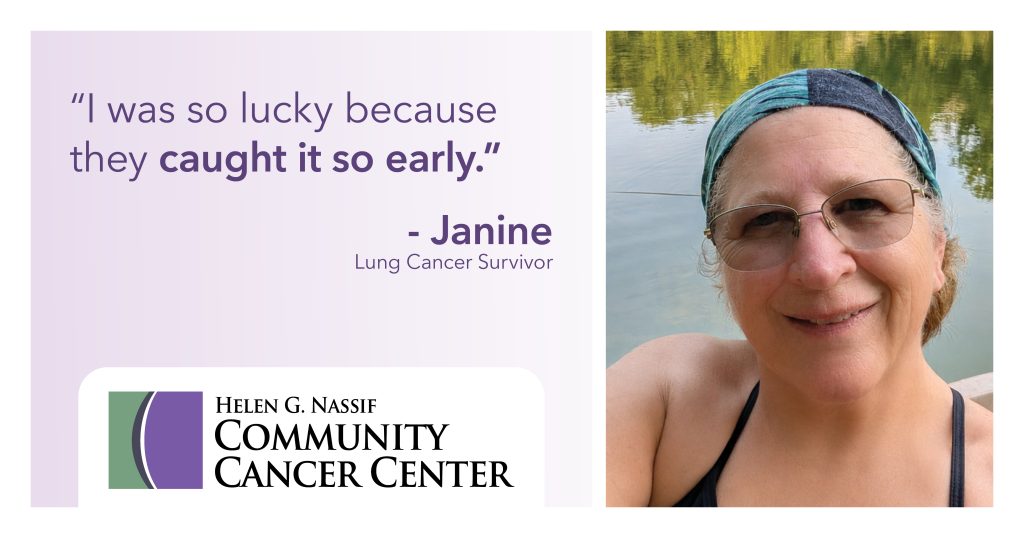
“I was so lucky because they caught it so early,” she said. “If I had put it off, God knows what would have happened.”
Today, Walters asks others to think about what matters most in their own lives.
“Take a look at your life and everything that is precious in your life,” she said. “Is it worth it to lose it for a cigarette?”
Experienced Lung Cancer Care
Lung cancer screening is recommended for current or former smokers who quit within the past 15 years, are ages 50 to 80*, and have smoked a pack a day for 20 years or two packs a day for 10 years. For more information about lung cancer screening, talk to your primary care provider or visit communitycancercenter.org/lung.
If you’ve been diagnosed with lung cancer, or any type of cancer, the Nassif Community Cancer is here for you. For more information on our extensive offering of support services, call (319) 558-4876 or visit communitycancercenter.org.
*Screening is recommended through age 80. Medicare coverage currently ends at age 77.