

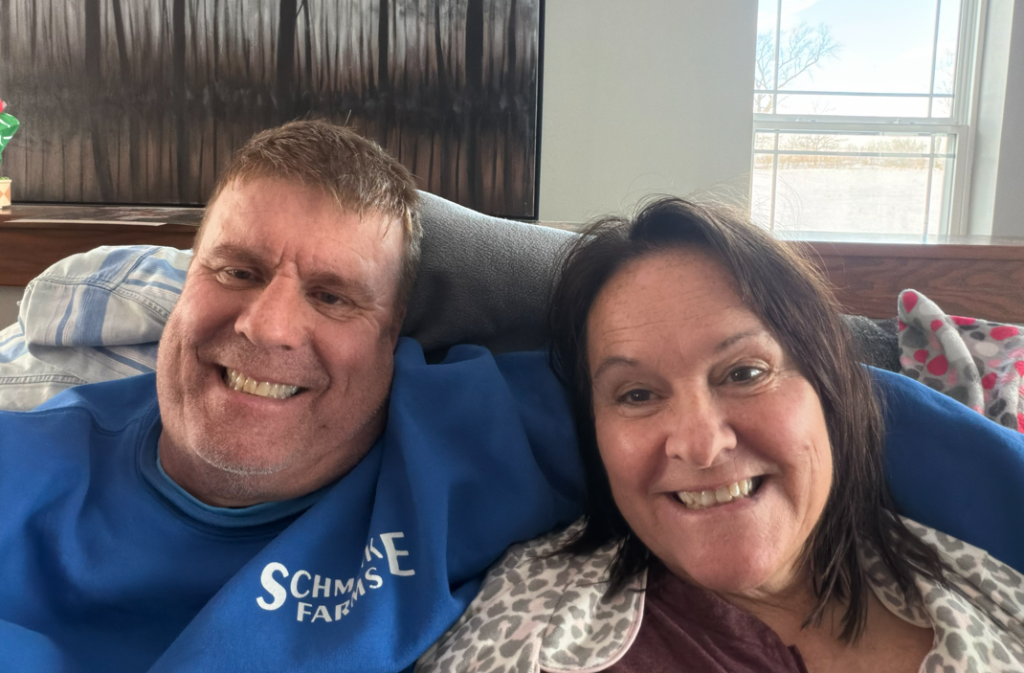
When Julie Pladsen had her routine mammogram in November 2025, she wasn’t experiencing any symptoms and had no reason to believe anything was wrong.
While attending a bone density appointment at Virginia Gay Hospital, Julie asked whether she could complete her mammogram that day instead of waiting for her scheduled appointment later in the month.
“I just had a push that I should get it done,” Pladsen said.
A few days later, she received a call that additional imaging was needed. The callback didn’t initially alarm her because she had been called back for additional imaging in previous years due to dense breast tissue.
Days later, a biopsy confirmed Stage 1B invasive lobular carcinoma.
“I was shocked,” Pladsen said. “I had no symptoms. There was nothing that would have made me think I had breast cancer.”
Support When She Needed It Most
Just minutes after Pladsen’s primary care provider notified her of her diagnosis, her cell phone rang.
“I turned to my coworker and said, ‘Do you think it’s the cancer center?’” Pladsen recalled. “She said, ‘Julie, it’s been five minutes.’ So, I didn’t answer. Then my work phone rang.”
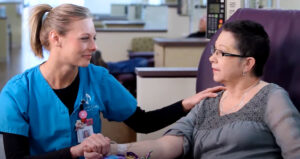
It was Kimmie Carney, RN, ACLS, BLS, care coordinator at the Nassif Community Cancer Center. Care coordinators serve as a patient’s constant point of contact—guiding them from diagnosis through treatment and beyond.
“She asked if my husband and I could be there that afternoon at 3 p.m.,” said Pladsen. “And I said, ‘Yes.’”
Julie and her husband, Jeff, met with Carney to begin discussing the road ahead. During their meeting, Carney answered questions, explained what to expect and helped them understand the next steps in Julie’s care.
“The first thing Kimmie asked was, ‘Can we pray together?'” Pladsen said. “That’s when we knew we were in the right place. It was so relieving knowing she was there to help. Anything we needed, she would do for us.”
Over the weeks that followed, Carney helped coordinate appointments, connect her with resources and remained a trusted point of contact whenever questions arose. With a care plan in place and a team she trusted, Pladsen felt ready to move forward.
“She laid everything out for me,” she said. “I knew exactly what was going to happen.”
A Team She Could Trust
Pladsen met with her surgeon Kerri Nowell, MD, FACS, and her oncologist Rasa Buntinas, MD, both with Physicians’ Clinic of Iowa, to discuss her treatment options. She chose to undergo a bilateral mastectomy performed by Dr. Nowell and the procedure and recovery went even more smoothly than she expected.
“Dr. Nowell did such a great job,” Pladsen said. “I went home without even having any pain medicine my whole recovery.”
Additional testing showed no evidence of cancer in Julie’s lymph nodes, and she ultimately did not require chemotherapy or radiation. Throughout treatment, Julie appreciated having a team she could trust and a clear understanding of what came next.
“There were no surprises,” she said. “Everybody explained everything.”
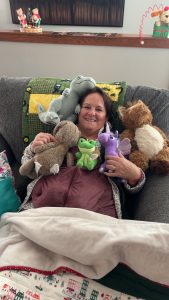
Encouraging Others to Get Screened
Today, Pladsen is open about her experience and hopes her story encourages others to prioritize routine screenings.
“If anything, it’s made me ask more people, ‘When was your last mammogram?'” she said.
She recalled recently talking with a woman who had been postponing her mammogram. After hearing Julie’s story, the woman scheduled her screening. Moments like that are why Julie continues sharing her experience.
“I’m not afraid to tell my story,” she said.
Her Message is Simple
Looking back, Pladsen is grateful she followed through with her mammogram when she did. Because she wasn’t experiencing symptoms, it’s possible her cancer could have gone undetected for a while longer. That’s why her advice for other women is straightforward:
“Listen to your provider, get your mammogram done and listen to your body.”
For Pladsen, a routine screening mammogram led to an early diagnosis, a successful treatment plan and a new mission: encouraging others to make their health a priority before symptoms ever appear.
Experienced Breast Cancer Care in Cedar Rapids
The Nassif Community Cancer Center provides comprehensive cancer care and support services for patients and families throughout the cancer journey. To learn more about breast cancer care and support services, call (319) 558-4876 or visit communitycancercenter.org.
Get Your Annual Screening Mammogram
It’s recommended women start with a baseline mammogram between the ages of 35-40, then begin annual screening mammograms at age 40, or sooner if there’s a family history of breast cancer. To schedule your mammogram, talk to your healthcare provider or call (319) 369-7216 to schedule your mammogram at one of St. Luke’s Breast and Bone Health’s three convenient locations. You can also request a mammogram appointment online at uph.link/CR-RequestAMammogram. St. Luke’s Breast and Bone Health also offers walk-in mammograms Monday through Friday from 9 a.m. – 3 p.m., with a doctor’s order.