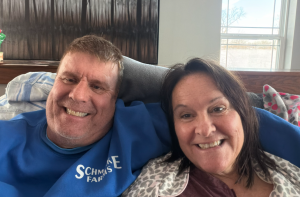



After delaying a colonoscopy, a Marion woman was diagnosed with colon cancer and now urges others to get screened early to detect and prevent the disease.
Christi Stauber of Marion sought medical care last June after experiencing symptoms she initially believed were related to constipation. Although her symptoms were briefly relieved, her condition soon worsened, including persistent vomiting and an inability to keep food down, indicating a more serious underlying issue.
“Three CT scans with contrast later, I was being transported to St. Luke’s Hospital because they found a grapefruit-sized mass in my lower colon,” Stauber recalled.
At the hospital, additional scans and blood work confirmed colon cancer—a diagnosis that may have been caught earlier with a screening colonoscopy. She was scheduled for surgery the next day.
A Life-Saving Surgery
Performing Stauber’s procedure was Rebecca Milburn, MD, general surgeon with Physicians’ Clinic of Iowa. During surgery, Dr. Milburn removed the mass, along with approximately four feet of Stauber’s colon, took biopsies for testing and inserted a temporary ostomy bag.
“After surgery, I learned the mass hadn’t protruded outside the colon yet,” said Stauber. “She said a mass that size usually indicates the cancer has spread. I was lucky mine didn’t.”
Stauber later met with her oncologist, Bharat Jenigiri, MD, also with Physicians’ Clinic of Iowa. Because the cancer hadn’t spread, Dr. Jenigiri recommended a close monitoring program consisting of a CT scan, blood work and a colonoscopy every three months.
Since her diagnosis, Stauber has undergone two colonoscopies—both performed by Dr. Milburn—during which several precancerous polyps were found and removed. She will continue this monitoring program for the foreseeable future with the team at UnityPoint Health – St. Luke’s Gastroenterology.
“I would recommend Drs. Jenigiri and Milburn to anyone,” said Stauber. “Dr. Jenigiri is very personable and explains things clearly, even when I was still in shock. And Dr. Milburn is very knowledgeable. She’ll say, ‘These are your options, and this is what I feel is in your best interest. Let’s talk about it—how do you feel?’”
A Missed Opportunity for Early Detection
The two colonoscopies Stauber has had since her surgery were her first—despite becoming eligible for screening in May 2021 when the United States Preventive Services Task Force lowered the recommended screening age from 50 to 45. Stauber, 47 at the time, elected to do a Cologuard test instead.
“I knew what to expect when having a colonoscopy, and I just didn’t want to do it, to be quite honest,” she said. “So, I did a Cologuard, which came back positive. But I was sick at the time and dealing with hemorrhoids, so I assumed that caused the positive result. I chose to leave it alone and not do further testing until I ended up in the ER last year.”
Cologuard, and other alternative screening tests, have grown in popularity in recent years due to their less invasive nature and no prep requirement prior to the procedure. While these options may seem more appealing on the surface, they don’t offer the same level of detection and prevention as a screening colonoscopy.
“Because these alternative tests aren’t looking inside the colon, cancer may not be detected,” said Doug Purdy, MD, St. Luke’s Gastroenterology. “Additionally, most of these tests have a 50% or lower polyp detection rate and have been known to miss significant polyps that could become cancerous within a few years. With screening colonoscopy, the physician can visually examine the colon, identify any abnormalities, take biopsies, and remove polyps—preventing them from turning into cancer.”


A Message That Could Save Lives
Looking back, Stauber wishes she would have opted for the colonoscopy and hopes her story encourages others to get their screening colonoscopy as soon as they’re eligible.
“Please listen to your doctor. They do have your best interest in mind,” she said. “I’m a prime example of what can happen if you don’t. If they find cancer sooner, it’s easier to take care of versus having part of your colon removed and living with an ostomy bag.”
She also wants to reassure those who are hesitant to have a colonoscopy because of the prep that it’s not as bad as some people make it out to be, and it’s far better than going through colon cancer.
“The prep tastes a little salty, but it’s really not that bad,” she said. “And knowing it’s going to clean out your colon so they can find the polyps that may be dangerous later is worth it.
“No one has to go through what I’m going through right now,” Stauber continued. “I’m not currently able to enjoy my hobbies like kayaking and working out without modification because of my ostomy bag. And my diet is very restricted. I wouldn’t wish this on anybody. Please get your colonoscopies.”
Get Your Screening Colonoscopy
Screening colonoscopies are recommended beginning at age 45, or earlier for those with a family history of colon cancer. To schedule your colonoscopy, talk to your primary care provider or visit uph.link/Gastroenterology-Screening-Form to request a screening colonoscopy today.
Experienced Colon Cancer Care
If you’ve been diagnosed with colon cancer, or any type of cancer, the Nassif Community Cancer Center is here for you. For more information about our extensive offering of support services available to all cancer patients and survivors—regardless of where they were treated—call (319) 558-4876 or visit communitycancercenter.org.