



Keith Hindman, 67, of Swisher, has always lived an active life. So when he was diagnosed with prostate cancer, he was determined not to let it slow him down. With the support of his care team at the Nassif Community Cancer Center, he didn’t have to.
From Routine Screening to Diagnosis
Hindman began getting his prostate-specific antigen (PSA) levels checked annually several years ago, as recommended by his primary care provider. Over time, his PSA levels increased, leading to a referral to Jonathan Rippentrop, MD, with Physicians’ Clinic of Iowa Urology, for closer monitoring.
“In fall 2021, my PSA increased to the point where they wanted to do a biopsy,” recalled Hindman. “I was diagnosed with prostate cancer and elected to have Dr. Rippentrop perform robotic surgery to remove my prostate.”
After surgery, things appeared to be under control—for a while.
By fall 2025, Hindman’s PSA levels were rising again. The cancer had returned, and this time, radiation treatment was recommended at UnityPoint Health – St. Luke’s Nassif Radiation Center.
Finding Strength Through Support
Daily radiation treatments weren’t easy, but Hindman credits his support team at the Nassif Community Cancer Center for helping him stay the course.
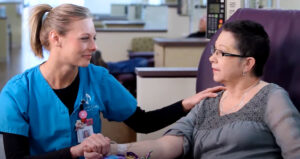
His social worker, Kyann Banghart, LBSW, met with him regularly after treatments, offering encouragement and reassurance.
“I wanted to quit after the first week of treatment,” Hindman said. “Kyann is the reason I was able to keep going.”
He also received nutrition guidance and genetic testing, working with Chloe Bilitz, MCN, RD, LD, CNSC, oncology dietitian, and Melissa Janssen, ARNP, genetics nurse practitioner, respectively.
“I eat pretty well, but it was very helpful meeting with Chloe,” Hindman said. “She gave me some recommendations to help with my nutrition during treatment. She even gave me a cookbook to take home.
“When we met with Melissa, she took plenty of time with us to go over details of my family history and explain everything clearly,” he continued. “The results came back negative for a genetic mutation. It was well worth it to do the testing and know it wouldn’t affect my kids or grandkids.”
Healing Through Movement and Connection
Hindman also relied heavily on the Community Cancer Center’s exercise program as an outlet to relieve stress from treatment. He worked with both cancer exercise specialists Matt Schmitz, CSCS, CES, AFT, and Sayde Alexandrescu, MSES, MSYT, RYT, ACSM-CEP in both individual and open gym settings.
“From day one, I would go to the gym upstairs after radiation,” he said. “I would meet with Matt and Sayde once a week on different days. I’d also go to open gym and do yoga and tai chi too. It helped me relax. You don’t usually think of exercise that way, but I needed that outlet.”
The program also helped him to make meaningful connections with both the care team and fellow patients – he even found a new pickleball partner.
“I’m an avid pickleball player and I met another patient who had already been through treatment and was also an avid player,” Hindman said. “We’ve played some pickleball together. It was nice to make a new friend who understood what I was going through, and I wouldn’t have made that connection if I hadn’t been going to the exercise program.”
Schmitz and Alexandrescu provided Hindman support that went above and beyond simply providing exercise guidance.
“Every interaction with them was so caring,” he said. “They took a real personal interest in me. One of the days I was going to meet with Sayde, my 95-year-old mother had fallen and wasn’t doing well. I told Sayde I wouldn’t be able to meet. But when I arrived at the radiation center, she was waiting for me, gave me a hug and told me she was thinking of me. That meant a lot.”


Advice for Others Facing Cancer
Today, Hindman has completed treatment and continues to stay active in survivorship.
For those who read his story, he hopes the takeaway is how beneficial it is to stay active during treatment and beyond, for both your physical and mental health.
“It has helped me tremendously during and after treatment,” he said. “Even if you’re not feeling up to it physically or you think your mind isn’t in the right spot, you need to make it part of your routine. If you’re already there for treatment or an appointment, just head upstairs and do it. It will help you keep your physical shape and your sanity through the whole process.”
Experienced Prostate Cancer Care
If you’ve been diagnosed with prostate cancer—or any type of cancer—the Nassif Community Cancer Center is here for you. For more information about our extensive offering of support services available to all cancer patients and survivors—regardless of where they were treated—call (319) 558-4876 or visit communitycancercenter.org.