

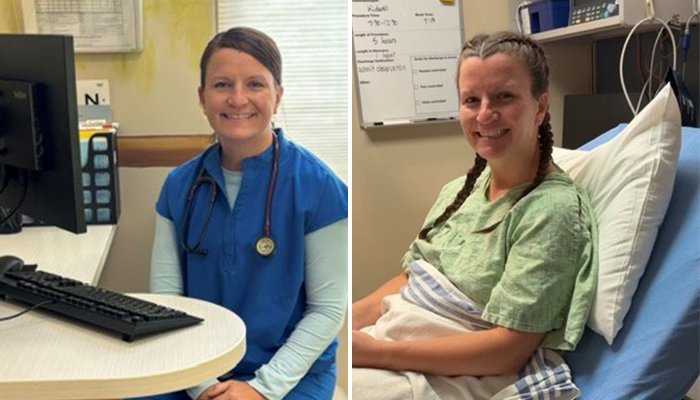
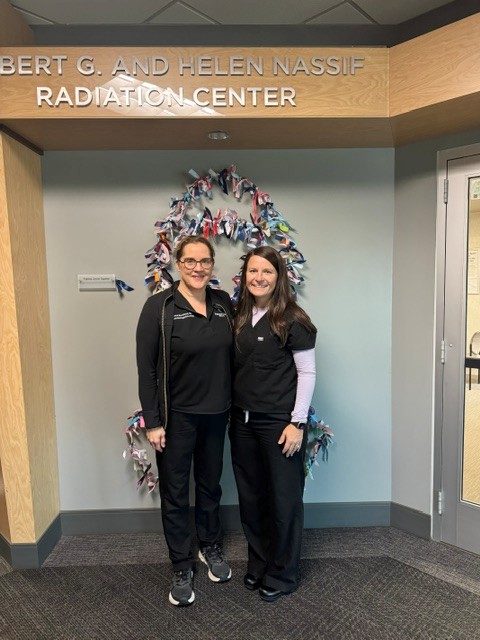
Kim Stromert of Solon spends her days caring for children as a nurse practitioner at UnityPoint Clinic Pediatrics – Hiawatha. But she recently found herself on the other side of care—as a patient at the Nassif Community Cancer Center—after cancer was found during a breast MRI.
Proactive Screening Pays Off
Stromert first found a lump during a self-exam at age 38, six years earlier. She went to her primary care provider, Nikki Woolley, DNP at UnityPoint Clinic Family Medicine – Westdale, who referred her for a mammogram.
Thankfully, the lump was benign, but the mammogram revealed that she has dense breast tissue. Because of this, she was advised to alternate mammograms and MRIs every six months as a proactive screening measure.
She stuck with that program—and it paid off. A suspicious spot was found during her December 2025 MRI and later confirmed to be cancer after a biopsy.
“If I wouldn’t have done the supplemental MRIs, we probably wouldn’t have found this,” Stromert said.
A Constant Through It All: Care Coordination
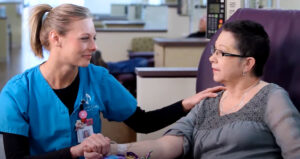
The first call Stromert received after her biopsy came from her care coordinator, Mona Cook, BSN, RN, CBCN. Care coordinators serve as a patient’s constant point of contact—guiding them from diagnosis through treatment and beyond.
“Mona called to tell me what the diagnosis was and exactly what it meant,” Stromert said. “I then went to meet with her, and we scheduled appointments with my surgeon and oncologist. She just checked in on how I was doing. At that point, you don’t really know what the future looks like, and she really helped calm my nerves.”
Stromert first met with her oncologist, Rasa Buntinas, MD, with Physicians’ Clinic of Iowa.
“Dr. Buntinas was a wealth of knowledge and always made us feel heard,” said Stromert. “With me being in the medical field and my husband not being medical, she did a great job of talking to both of us in a way we could each understand.”
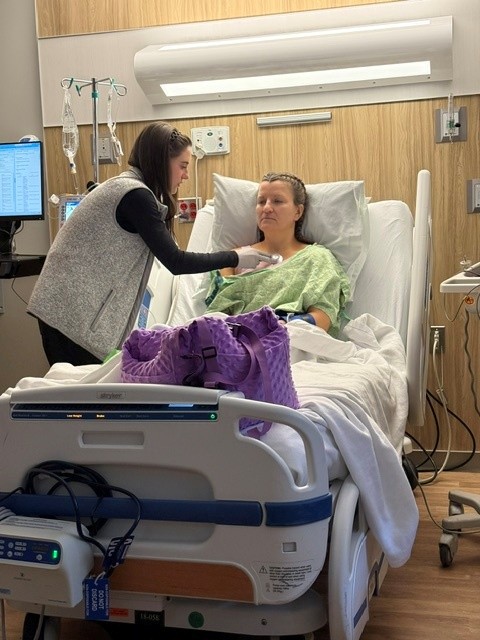
Next came appointments with surgeons Kerri Nowell, MD, FACS, general surgeon, and Vanessa Leonhard, DO, plastic and reconstructive surgeon, both with Physicians’ Clinic of Iowa. After talking with Dr. Nowell, Stromert elected to have a mastectomy – a procedure to remove all the tissue in the breast – which occurred in January 2026. Three months later, Dr. Leonhard performed her reconstruction surgery.
“I can’t say enough good things about them,” Stromert said. “Dr. Nowell had amazing bedside manner and had this calming effect that made me feel very confident going into surgery. And with Dr. Leonhard, I felt like we were a team figuring out what I wanted to do for reconstruction. We created a relationship where I feel like she knows me personally and that also put me at ease.”
Support Services Provide Comprehensive Care
In addition to her surgeries, Stromert also took advantage of the support services offered at the Community Cancer Center. With her strong family history of cancer, she was referred to the Genetics & Cancer Risk Assessment Clinic where she met with Alyssa Grissom, MSN, APRN, AGCNS, AOCNS.
“It was very interesting to look through my family history and see where there may be some correlations between different family members,” recalled Stromert. “The test came back negative for any genetic abnormalities, so it was a relief knowing I wouldn’t pass anything down to my children.
“We also talked with Alyssa about environmental factors and things we can control,” she continued. “We’ve had water and radon testing done on our home and are doing what we can to mitigate the risks for our family.”
Stromert received pre- and post-op support from Matt Schmitz, CSCS, CES, AFT, cancer exercise specialist, who has worked with her on range of motion and regaining strength.
“Matt was absolutely amazing,” she said. “He helped me get my range of motion back to where it was before surgery and since my second surgery, I’ve been working with him on strength training.”
Stromert also leaned on Barb Lorenz, LBSW, oncology social worker, who provided support not only for her, but for her family as well.
“Barb made us feel very cared for. We weren’t just another patient or appointment for her,” said Stromert. “She checked in on my husband and even brought books and stuffed animals for each of my kids. That made me cry. It was so touching.”
Be Your Own Advocate
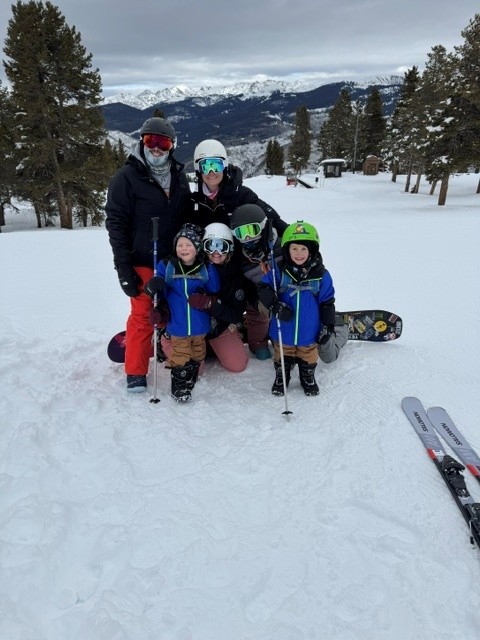
Stromert is now back at UnityPoint Clinic Pediatrics – Hiawatha following her recovery. She returns not only as a provider, but as a survivor who now passionately encourages moms to prioritize their own health as well.
“I cannot stress enough the importance of supplemental screening and being an advocate for your own health,” she said. “Have regular physicals, follow up on screenings and get supplemental screenings if needed. And if you feel like something’s off, trust your gut and talk to your doctor.”
Experienced Breast Cancer Care
If you’ve been diagnosed with breast cancer, the Nassif Community Cancer Center is here for you. For more information about the Community Cancer Center and our extensive offering of support services, call (319) 558-4876 or visit communitycancercenter.org.
Get Your Annual Screening Mammogram
It’s recommended women start with a baseline mammogram between the ages of 35-40, then begin annual screening mammograms at age 40, or sooner if there’s a family history of breast cancer. To schedule your mammogram, talk to your healthcare provider or call (319) 369-7216 to schedule your mammogram at one of St. Luke’s Breast and Bone Health’s three convenient locations. St. Luke’s Breast and Bone Health also offers walk-in mammograms Monday through Friday from 9 a.m. – 3 p.m., with a doctor’s order.