


From the shoreline to the starting line—facing cancer, finding strength, and paddling forward together
Michelle Lange of East Dubuque, IL, has been a regular on the waters of the Mississippi for over two decades, racing dragon boats with a group of fellow breast cancer survivors. The two-time survivor always loved having her daughter Abbey Lange, of Cedar Rapids, cheer her on from the shores but wished Abbey would never have a reason to join her in the boat.
Unfortunately, that wish didn’t last. There is only one requirement to join Team “Hope for the Breast”: a breast cancer diagnosis – which Abbey received at just 32-years-old.
Trusting her Instincts When Something Didn’t Feel Right
In late 2022, Abbey felt a lump in her breast. She was very much into working out and thought maybe she was feeling a muscle but given her family history – Michelle was first diagnosed at age 38 – she decided to have it checked out. It was a wise decision.
“I went to my doctor and was referred for a biopsy,” recalled Abbey. “At the biopsy, they told me they were 95% sure it was cancerous. My parents were on vacation at the time, and I had to call my mom while they were in California to tell her. That was really hard.”
Abbey received results later that day confirming the diagnosis and was referred to the Nassif Community Cancer Center to meet with her care coordinator, where they’d begin to form a personalized care plan.
Coordinated Care from Day One
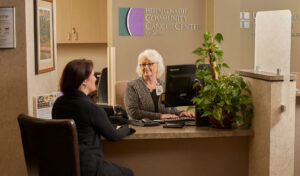
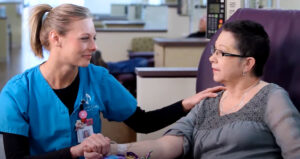
A care coordinator is a patient’s constant point of contact throughout the cancer journey, from diagnosis through treatment and beyond. Abbey and her parents met with Mona Cook, BSN, RN, CBCN, who talked them through next steps and got her scheduled for appointments with her providers.
“Mona was so sweet,” said Abbey. “I kind of blacked out during that appointment, but I do remember her asking, ‘Do you understand?’ ‘Can I explain anything better or different?’ She was soft and comforting in her approach. Even though I was terrified for my life, I felt comfort in my interactions with her.”
Cook scheduled Abbey to meet with William Fusselman, MD, oncologist, and Alexandra Bors, MD, FACS, surgeon, both with Physicians’ Clinic of Iowa. She underwent 20 rounds of chemotherapy and, after discussions with her physicians, elected to have a double mastectomy – a surgery to remove the tissue of both breasts – to minimize the risk of recurrence. She also had breast reconstruction surgery immediately after performed by David Jerkins, MD, plastic and reconstructive surgeon with Physicians’ Clinic of Iowa.
“I’ve formed a really close bond with my doctors through all the appointments,” said Abbey. “Dr. Fusselman always has a smile on his face and tries to make me smile and keep it light. And every time I see Dr. Jerkins he’s like, ‘Your hair is getting longer!’ So that’s been nice. I really like them a lot. And the girls on the chemo floor really helped me get through a lot. I still stop by and say hello to them when I come in for my follow-ups.”
Support Services Beyond Treatment
Abbey has taken advantage of the support services offered at the Nassif Community Cancer Center, including pursuing genetic testing soon after her diagnosis.
“I found I have a PALB2 gene mutation,” shared Abbey. “It means I’m at higher risk for developing breast and ovarian cancer. Knowing I have this mutation gives me more insight and I’m able to be more proactive and make sure I’m getting checked. It puts me ahead of the game.”
While going through chemo, Abbey experienced hair loss. While it’s a common side effect, for many patients it means losing part of their identity. Thankfully, through the Community Cancer Center’s partnership with Strands of Strength, Abbey received a voucher to help obtain a wig.
“I started losing my hair, so I made the choice to shave it off,” she said. “The social workers, Nancy [Yeisley, MSW, LISW, OSW-C] and Barb [Lorenz, LBSW] gave me the Strands of Strength voucher and connected me with a salon. Until you go through it, you don’t know what it’s like to not feel like yourself. Getting that wig really made me feel like me.”
Since completing treatment, Abbey has worked with Matt Schmitz, CSCS, CES, AFT, cancer exercise specialist at the Community Cancer Center, to rebuild her strength and get her ready for upcoming dragon boat races.
“People think the recovery only happens immediately after surgery, but I’ve been able to go back to Matt even to this day to get his advice about working out with what my body is now after the surgeries,” she said. “I’ve been seeing him every three weeks to work on strengthening my upper body for an upcoming dragon boat race in France. He’s been so awesome and is one of my favorite people.”


Paddling Through Survivorship Together
Abbey’s journey mirrored one her mom knew all too well. Michelle was diagnosed with breast cancer first in 2003, and then again in 2005. Like Abbey, she went through chemo and surgery, and also had radiation treatments at the UnityPoint Health – Wendt Regional Cancer Center in Dubuque, IA, where she now works as an experience specialist.
After her first diagnosis, a fellow survivor encouraged her to try dragon boating.
“I didn’t want to go. I just wanted to stay in the house and hide,” said Michelle. “But there is life after cancer. You can live a normal life. Now I’ve been dragon boating for 22 years and it’s like a floating support group.”
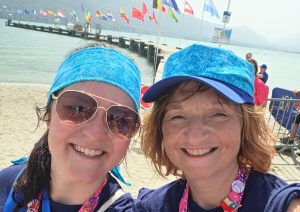
After completing her treatment, Abbey joined her mom on the team. While Michelle never wanted her daughter to go through cancer, the opportunity to race together is one she cherishes. In August, they will head to Aix-les-Bains, France along with other members of Team “Hope for the Breast” for the 2026 International Breast Cancer Paddlers’ Commission (IBCPC) Dragon Boat Festival – a gathering of more than 4,500 survivors from 25 countries who come together to lift each other up and participate in friendly dragon boat racing competition.
“It just about broke me when I found out Abbey was diagnosed. It was my worst fear,” said Michelle. “But it’s brought us closer together. These memories are something we’ll always share, and I’m so excited for her to experience the international trip.”
“No parent wants to see their child go through cancer, but my mom was my rock,” Abbey added. “It’s comforting to know she’s there and understands. I think it’s so special, after embracing this hard journey we’ve both experienced, we get to take this trip together.”
To learn more about Michelle and Abbey’s trip to France, click here.
Team Hope For the Breast is always looking for more survivors to add to their team. Breast cancer survivors who are interested can learn more here.
Their Message for Women: Early Detection Matters
Michelle and Abbey hope their story inspires those who read it in many ways, but more than anything, they hope it inspires women to get their mammograms every year.
“Before I worked at the Wendt Cancer Center, I worked in another medical office and I’d hear patients who were like 50-years-old say they’d never had a mammogram because they were scared,” said Michelle. “I wanted to stress to them how important mammograms are. It may be uncomfortable, but it doesn’t hurt, and early detection can save your life. It saved mine.”
“You may be scared of the results, but taking the right steps can potentially save your life,” agreed Abbey. “If you’re diagnosed, it’s important to never give up. Don’t stop fighting and don’t ever think you can’t beat it. Believe in yourself, have a positive mindset and that’s what will get you through.”
Now, as Abbey paddles forward – from the Mississippi River where she once cheered her mom on from the shore to Lake Bourget in France, where they will race together as survivors – she hopes their story offers encouragement to others navigating rough waters of their own.
Experienced Breast Cancer Care
If you’ve been diagnosed with breast cancer, the Nassif Community Cancer Center is here for you. For more information about the Community Cancer Center and our extensive offering of support services, call (319) 558-4876 or visit communitycancercenter.org.
Get Your Annual Screening Mammogram
It’s recommended women start with a baseline mammogram between the ages of 35-40, then begin annual screening mammograms at age 40, or sooner if there’s a family history of breast cancer. To schedule your mammogram, talk to your healthcare provider or call (319) 369-7216 to schedule your mammogram at one of St. Luke’s Breast and Bone Health’s three convenient locations. St. Luke’s Breast and Bone Health also offers walk-in mammograms Monday through Friday from 9 a.m. – 3 p.m., with a doctor’s order.