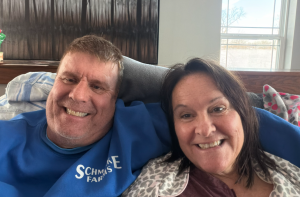
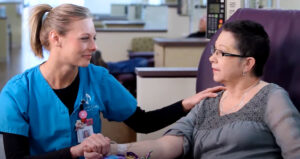



Early detection, coordinated care and comprehensive support made all the difference for Barb during her breast cancer journey.
When Barb Schemmel, of Cedar Rapids, went in for her appointment last October, she expected it to be routine. The next day, her phone rang.
“They said they needed more images and a possible biopsy,” recalled Schemmel. “I went in and they did some more imaging. They said it looked like a cancer but would need to do a biopsy to know definitively.”
Results showed stage 1A breast cancer. Upon receiving the diagnosis, Schemmel was referred to the Nassif Community Cancer Center, where her care team stepped in immediately to form a care plan. It all started with a call from her care coordinator, Mona Cook, BSN, RN, CBCN.
Care Coordination Sets the Tone for a Seamless Cancer Journey
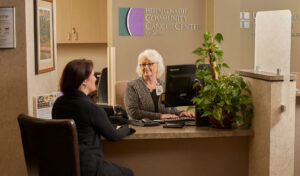
A care coordinator is a patient’s constant point of contact throughout the cancer journey, from diagnosis through treatment and beyond. Schemmel and her husband went to meet with Cook, who talked them through next steps and got her scheduled for appointments with her providers.
“Mona was wonderful and explained everything in detail,” said Schemmel. “She gave us a layout of the decisions I may be presented with and what I could expect.”
Schemmel selected her oncologist, Rasa Buntinas, MD, and surgeon, Kerri Nowell, MD, FACS – both with Physicians’ Clinic of Iowa – and Cook set up appointments with both for the next day.
“I was so impressed with the coordination of care,” shared Schemmel. “If I had two upcoming appointments, they’d schedule them on the same day, so I didn’t have to go and come back. They were very thoughtful and made things as simple as they could for me. It was just so seamless.”
A Personalized Treatment Plan
Because her cancer was caught in an early stage, Schemmel did not need chemotherapy. The first step in her treatment was surgery. She chose to have a lumpectomy – a procedure to remove the cancerous tumor – which was performed on November 10 by Dr. Nowell.
“Dr. Nowell was great. In my appointment with her, she explained my options and discussed the outcomes with me,” said Schemmel. “We decided to schedule a lumpectomy. Everything went great on the day of surgery, and I was home the same day.”
Schemmel had a break following surgery before starting radiation treatments on January 8. Her care plan, overseen by Jessica Parkhurst, MD, radiation oncologist at St. Luke’s Nassif Radiation Center, consisted of five treatments over the course of a week and a half.
“Dr. Parkhurst and the team were wonderful. They were all so patient and answered any question I had,” said Schemmel.
Support Services Through Treatment and Beyond
During and after her treatment, Schemmel has taken advantage of the support services available to patients and survivors at the Community Cancer Center.
“I saw Renee [Grummer-Miller, MSW, LISW] and Kyann [Banghart, LBSW], the social workers,” she said. “They were very, very nice. We went over resources and services available, and they said they’re always there if I have any questions or need assistance.”
Schemmel has been involved with the exercise program as well, having both one-on-one consultations with Sayde Alexandrescu, MSES, MSYT, RYT, ACSM-CEP, exercise program specialist, and participating in group exercise classes and open gym.
“I was set up with Sayde and she showed me all the exercise options I could take advantage of,” said Schemmel. “She also gave me some exercises to do for strengthening and recommendations to help maintain my bone density.”
What Schemmel was most impressed with was the fact that Community Cancer Center support services are available to all cancer patients and survivors at little to no cost, regardless of when or where they were treated.
“I have a good friend who had breast cancer several years ago and had treatment at another hospital,” she said. “Sayde told me she’s welcome at the Community Cancer Center. I’m going to let her know. I think that’s a really nice thing to offer the community.”
Barb’s Advice: Don’t Skip Your Mammogram
Schemmel wants those who read her story to start regular screening mammograms if they aren’t already having them done.
“I have no family history, and I’m not considered a high-risk individual,” she said. “I feel incredibly fortunate to have caught it early. Get your mammograms because knowledge is power.”
And for those who face the uncertainty of a breast cancer diagnosis, she offers reassurance.
“There’s such an amazing group of people here to help you with everything,” she said. “It doesn’t matter what it is. Somebody will be there to help you through it in such a patient, kind and informative way.”
Experienced Breast Cancer Care
If you’ve been diagnosed with breast cancer, or would like to pursue genetic testing, the Nassif Community Cancer Center is here for you. For more information about the Community Cancer Center and our extensive offering of support services, call (319) 558-4876 or visit communitycancercenter.org.
Get Your Annual Screening Mammogram
It’s recommended women start with a baseline mammogram between the ages of 35-40, then begin annual screening mammograms at age 40, or sooner if there’s a family history of breast cancer. To schedule your mammogram, talk to your healthcare provider or call (319) 369-7216 to schedule your mammogram at one of St. Luke’s Breast and Bone Health’s three convenient locations. St. Luke’s Breast and Bone Health also offers walk-in mammograms Monday through Friday from 9 a.m. – 3 p.m., with a doctor’s order.